
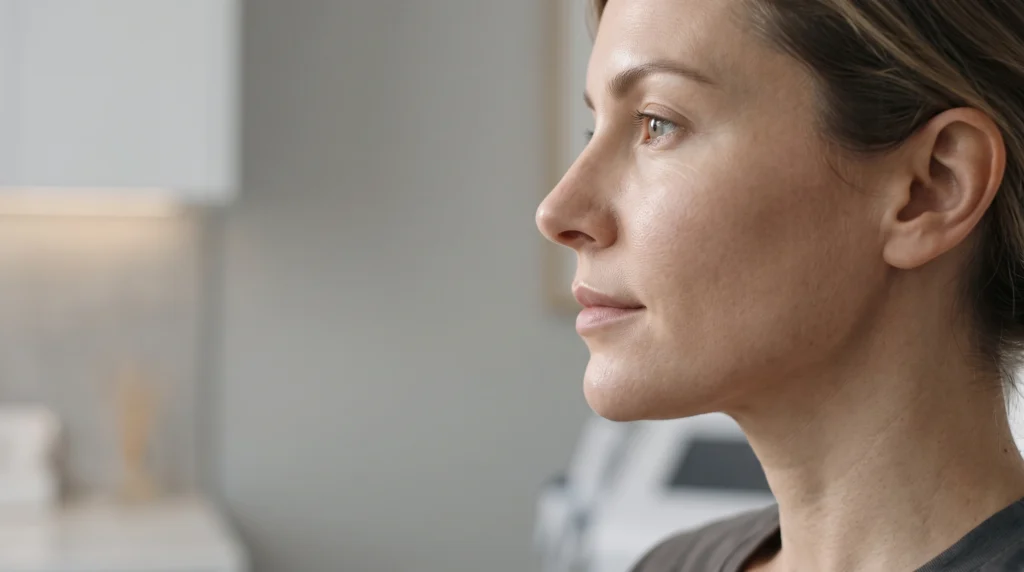
Sagging Jawline: Can Radiesse Help Restore Definition?
The jawline tends to give away age earlier than most people expect. A softening edge along the lower face usually shows up in photographs before it registers in the mirror, often in a side profile where the chin seems to melt into the neck or in a downward glance on a video call. Most people call the change sagging, and the word fits, though the process behind it runs deeper than gravity pulling on skin.
At Youth Lab Aesthetics in Meridian, Idaho, loss of jawline definition is one of the concerns patients raise most often, and Radiesse comes up in nearly every one of those conversations. In 2021 it became the first injectable approved by the U.S. Food and Drug Administration to improve moderate to severe loss of jawline contour. This guide walks through why the jaw loses its shape and where Radiesse fits into restoring it, including the cases where a different approach works better.
What Causes a Jawline to Lose Definition?
A defined jawline is the visible border formed by the lower edge of the mandible, the bone that anchors the lower face, together with the soft tissue that drapes over it. When that border is crisp, it casts a faint shadow onto the neck and separates the face cleanly from the throat. With age the border softens, and the change comes from two directions at once.
The first is structural. The mandible gradually resorbs over the decades, a normal part of skeletal aging that blunts the angle beneath the ear and shortens the chin. Deep fat compartments in the midface and lower face lose volume during the same years, so tissue that once sat high and full begins to slide downward. Where it meets the mandibular ligament, a fibrous attachment that tethers skin to bone just ahead of the jowl, that tissue gathers into a jowl and leaves a shallow hollow in front of it known as the pre-jowl sulcus.
The second is the drape itself. Collagen and elastin decline steadily from the mid-twenties onward, and skin loses the spring that once let it return to place. Thinner, looser skin then reveals every change in the structure beneath it. Genetics and cumulative sun exposure largely decide how early this begins, which is why some people notice jowling in their late thirties while others keep a sharp jaw well into their fifties.
What Is Radiesse, and How Does It Work on the Jaw?
Radiesse is a biostimulatory dermal filler made by Merz Aesthetics. It consists of calcium hydroxylapatite, or CaHA, microspheres suspended in a water-based carboxymethylcellulose gel. The microspheres measure 25 to 45 microns across and share their mineral composition with bone and teeth. The version approved for the jaw, known as Radiesse (+), also contains a small amount of lidocaine to keep the injections comfortable.
The product works in two phases. The gel and microspheres lift the tissue the moment they are placed, which is why patients see a sharper edge before they leave the clinic. Over the following weeks the gel is absorbed, and the microspheres act as a framework that prompts fibroblasts in the surrounding tissue to produce new collagen. The body slowly metabolizes the microspheres themselves, while the collagen they stimulated stays in place. Our page on Radiesse bio filler in Meridian, Idaho covers how we use the product across the face and hands.
Firmness is what suits Radiesse to the jaw in particular. The product has a high elastic modulus, often written as G prime, a measure of how well a gel resists being pushed out of shape. A firm product placed on bone behaves much like a small structural implant, holding a clean line and a defined angle. Softer hyaluronic acid fillers can add volume along the jaw as well, although they tend to settle into a more rounded border. For a closer look at that difference, see our guide to Radiesse vs. traditional fillers.
Key point. Radiesse restores jawline definition by rebuilding support at the level of the bone. It adds structure where the mandible has receded, then encourages your own collagen to reinforce the area over the months that follow. |
Where Is Radiesse Placed to Restore Definition?
Jawline treatment follows the anatomy of the mandible from the ear toward the chin. Injectors usually begin at the angle of the jaw, the corner beneath the earlobe, and establish that point before sculpting the rest of the line. Restoring a crisp angle does much of the visual work, since a blunted angle is often what makes the entire lower face read as heavy.
From there, product is placed along the body of the mandible and into the hollows on either side of the jowl. Filling the pre-jowl sulcus in front and the softer depression behind the jowl straightens the line, so the jowl blends into a continuous edge. Experienced injectors deliberately leave the jowl itself alone, because that compartment already carries excess weight and more volume would only add to it.
Most Radiesse along the jaw is placed deep, directly on the bone. That plane leaves plenty of tissue above the product to smooth the contour, and it keeps the injection away from most of the larger blood vessels. Small amounts are laid down slowly with either a fine needle or a blunt cannula, depending on the area and the injector’s preference.
Shape matters as much as volume. A softer, feminine jawline usually keeps the angle slightly forward and a touch higher, while a squarer masculine jaw extends it farther back toward the line of the ear. Jawline contouring has become a common first treatment for men in particular, many of whom are looking for a stronger angle more than any smoothing.
Good injectors also look above the jaw before they treat it. Restoring lost volume in the cheeks can lift some of the tissue that has slid toward the jowls, which often reduces how much product the jawline needs. That full-face view shapes how we plan dermal fillers in Meridian, Idaho, and it tends to produce a more balanced result than treating the jaw in isolation.
What Does the Research Show?
The jawline approval rested on a randomized, controlleed, evaluator-blinded trial conducted at multiple U.S. sites, and investigators continued following those patients for more than a year after treatment. Improvement was graded on the Merz Jawline Assessment Scale, a photographic scale developed specifically to rate jawline contour.
Worth knowing. In the long-term follow-up of that pivotal trial, published in the Journal of Cosmetic Dermatology, 62.9 percent of treated patients still showed at least a one-point improvement on both sides of the jaw 48 weeks after their initial injection. The authors also reported that the treatment was well tolerated throughout the follow-up period. |
Trial results describe averages across a group of patients. Your own outcome depends largely on your anatomy and on how readily your body builds new collagen, which is why a careful assessment matters more than any single figure.
Who Is a Good Candidate for Radiesse Jawline Treatment?
Radiesse jawline treatment works best when the main problem is lost structure and volume, and the skin still has enough quality to respond. In practice, strong candidates tend to fall into two groups:
- Adults over forty with mild to moderate jowling and a jaw angle that has gradually softened, who want the lower face to look straighter and more lifted
- Younger adults who want more sculpted contour or better facial symmetry, including many men looking for a sharper, more defined angle
The treatment is less effective when excess skin or fat is the main driver. Heavy jowling with loose overlying skin, or a fuller layer of fat beneath the chin, usually needs attention first, because filler placed beneath loose tissue has little to hold against. Patients with a naturally wide, square jaw also need a tailored plan, since adding volume at the angle can make the lower face look broader.
Your injector will review your medical history as well. Pregnancy or breastfeeding, bleeding disorders, active skin infections near the treatment area, and any history of severe allergies or lidocaine sensitivity can all change the plan or its timing.
How Does Radiesse Compare to Other Jawline Treatments?
A softer jawline rarely has a single cause, so it helps to see which treatment addresses which layer. The table below sets Radiesse alongside the other options patients most often ask about.
| Treatment | Primary target | Best suited to | How results develop |
|---|---|---|---|
| Radiesse (+) | Lost bone support and volume along the jaw | A blunted jaw angle or mild to moderate jowling | Immediate lift, with collagen building over the following months |
| Hyaluronic acid filler | Volume and softer contour | Chin projection and patients who want a reversible option | Immediate, and can be dissolved with hyaluronidase if needed |
| Kybella | Fat beneath the chin | Fullness under the chin that blurs the jaw from below | Gradual across several sessions as treated fat cells are cleared |
| XERF skin tightening | Loose or crepey skin | Mild to moderate laxity along the jaw and neck | Gradual firming as collagen remodels over several months |
| PDO smooth threads | Skin quality and light support | Early laxity and thinning skin in the lower face | Gradual collagen stimulation as the threads dissolve |
| Neuromodulator in the masseter | An enlarged jaw muscle | A wide, square lower face linked to clenching | Slimming develops over roughly two to three months |
These treatments often work best in combination. A patient whose jawline is blurred from below by fullness under the chin may start with Kybella in Meridian, Idaho before any filler is placed, so the new edge has room to show. When looseness is the larger issue, XERF skin tightening in Meridian, Idaho uses monopolar radiofrequency to firm the skin, and Radiesse can then add definition to tissue that sits more closely over the bone.
PDO smooth threads in Meridian, Idaho offer another route to gentle support and collagen stimulation in the lower face. Patients who prefer to firm the skin without injections can read our article on how ClearLift laser firms skin. Radiesse can also be thinned into a hyperdiluted form and spread across the lower face and neck to improve skin firmness, a technique your injector may suggest alongside jawline contouring.
What Happens During a Radiesse Jawline Appointment?
Treatment begins with a consultation and standardized photographs taken from the front and both sides, which give you and your injector a reliable baseline for later comparison. The injector then maps the jaw by touch and marks the plan on the skin, paying close attention to the point where the facial artery crosses the bone.
The injections themselves typically take 30 to 45 minutes. Because Radiesse (+) contains lidocaine, the area numbs quickly after the first few passes, and most patients describe the sensation as pressure more than pain. Your injector may gently mold the product afterward to smooth the contour.
The jaw usually needs more product than smaller areas such as the lips, since it is a long structure treated on both sides. Many patients need around one syringe per side for a visible change, and fuller corrections call for more. A staged approach is common and sensible: an initial session to rebuild the angle and main line, then a check-in once the tissue settles to decide whether any refinement is worthwhile.
What Does Recovery Look Like?
Most patients return to work the same day or the next. Swelling along the jaw is the most common effect, usually peaking in the first day or two and settling within about three days. Some tenderness when chewing is normal during that window, and bruising is possible, particularly where a cannula was fanned beneath the skin.
A short aftercare stretch protects the result while the product settles:
- Skip strenuous exercise and saunas for the first 24 to 48 hours, and keep alcohol to a minimum during that window
- Avoid firm pressure on the jaw for about a week, including tight chin straps and facial massage, unless your injector gives you specific massage instructions
Mention any dental work planned in the weeks around your appointment, since timing matters for injectables in the lower face. The visible result then evolves in two stages. The lift you see on day one comes from the gel and microspheres, and it looks slightly fuller while swelling lasts. The collagen response builds more slowly over the following two to three months, which is when the jaw tends to look its most natural and settled.
How Long Do Radiesse Jawline Results Last?
For many patients, Radiesse jawline results hold for around a year, and the collagen it stimulates can extend the benefit beyond that point. Longevity varies with metabolism and with the amount of product placed. The aging process that softened the jaw in the first place also keeps running in the background, so maintenance is part of any long-term plan.
Most patients return for a maintenance session somewhere between 12 and 18 months, often needing less product than at the first appointment because part of the new structure is still in place. Follow-up photos taken at each visit are the most reliable way to set your own schedule.
Is Radiesse Safe for the Jawline?
Radiesse has a long history in aesthetic medicine and a well-established safety profile when an experienced injector places it. Most side effects are short-lived reactions at the injection site, such as swelling and tenderness, which resolve within days.
Small lumps are uncommon and usually trace back to product placed too superficially or unevenly, which is one reason deep placement on the bone is standard for the jaw. The most serious risk with any filler is a vascular event, which occurs when product enters or compresses a blood vessel. Along the jaw, the facial artery crosses the bone just in front of the masseter muscle, and skilled injectors adjust their depth and technique at that exact point.
Radiesse differs from hyaluronic acid fillers in one important respect. HA can be dissolved with an enzyme called hyaluronidase, while Radiesse breaks down on the body’s own schedule. Detailed knowledge of facial anatomy and a slow, low-pressure injection technique therefore matter more with Radiesse than with most other fillers.
Frequently Asked Questions
Can Radiesse get rid of jowls?
Radiesse camouflages mild to moderate jowls by filling the hollows around them and restoring the line of the jaw, so the jowl blends into a straighter edge. Heavy jowling with significant loose skin usually calls for skin tightening, or a surgical opinion, alongside or in place of filler.
Will Radiesse make my face look wider?
Placed thoughtfully, it makes the lower face look more defined. Width becomes a concern mainly for patients who already have a broad, square jaw, and a good injector will adjust where the angle sits, or skip volume at the angle entirely, in those cases.
Can men get Radiesse for the jawline?
Yes. Jawline contouring is one of the more popular injectable treatments among men, who often want a sharper angle and a straighter line from ear to chin. The technique shifts slightly to build a squarer shape.
Can Radiesse be combined with other fillers?
Frequently. Many jawline plans pair Radiesse along the bone with a hyaluronic acid filler in the chin or lips, where a softer, reversible product suits the tissue better.
Why Youth Lab Aesthetics?
Jawline work rewards precision more than almost any other filler treatment. The product is firm and designed to hold its shape, and the anatomy along the mandible leaves little room for guesswork. At Youth Lab Aesthetics, our injectors assess the whole face before recommending anything for the jaw, because the most natural jawline results often begin with support higher up.
We plan jawline treatment in stages, starting with a conservative first session and a follow-up once the collagen response has had time to develop. That pacing lets us refine the angle and line with your real result in front of us, and it keeps the outcome in proportion with the rest of your face.
Book Your Jawline Consultation in Meridian, Idaho
If your profile has started to look softer than you feel, the most useful next step is an in-person assessment with an injector who treats the jawline regularly. Our clinic on West Ustick Road in Meridian welcomes patients from across the Treasure Valley. Book your consultation today and we will look at what is driving the change along your jaw, then explain whether Radiesse on its own or a combined plan fits your goals.
A defined jaw has always been built from the bone outward. Radiesse simply works from the same direction.
References
- Green JB, et al. “Long-term duration and safety of Radiesse (+) for the treatment of jawline.” Journal of Cosmetic Dermatology. 2024. https://pubmed.ncbi.nlm.nih.gov/38934231/
- Moradi A, Green JB, Kwok GP, Nichols K, Rivkin A. “Guidelines for Optimal Patient Outcomes Using Calcium Hydroxylapatite for Jawline Contour.” Aesthetic Surgery Journal Open Forum. 2023. https://pmc.ncbi.nlm.nih.gov/articles/PMC10120162/
- U.S. Food and Drug Administration. Summary of Safety and Effectiveness Data: RADIESSE (+) Lidocaine Injectable Implant, Jawline Indication (PMA P050052/S129). https://www.accessdata.fda.gov/cdrh_docs/pdf5/P050052S129B.pdf
Recent Blogs