AquaGold vs. Traditional Microneedling: Choosing the Right Treatment for Your Skin
The microneedling category has grown far beyond a single device or technique. What once described one procedure now covers a family of treatments that share the same general principle while delivering very different results. AquaGold and traditional microneedling sit at opposite ends of that spectrum.
Both treatments use fine needles to reach the deeper layers of the skin. Where they part ways is in what those needles do once they get there. At YouthLab Aesthetics in Meridian, Idaho, we want you to understand that difference before you book, because the best choice depends on your skin goals and your timeline.
How Traditional Microneedling Works
Traditional microneedling is a collagen induction therapy. A motorized pen or roller fitted with solid stainless steel needles passes across the skin in rapid, controlled motions, creating thousands of tiny channels in the upper layers.
The skin responds the way it would to any small injury. Fibroblasts, the cells responsible for producing collagen and elastin, switch into repair mode. Over the following weeks new collagen fills in those channels, and existing collagen rearranges itself into healthier patterns. Skin gradually becomes firmer and smoother.
The needles in a clinical microneedling device typically reach between 0.5 mm and 2.5 mm in depth. Your provider adjusts that depth to match the area of the face and the concern being treated. Fine lines around the eyes call for shorter needles, while deep acne scars on the cheeks may require longer ones.
Most clinical sessions take 30 to 45 minutes after a topical numbing cream is applied. The skin looks flushed afterwards, similar to a moderate sunburn, and that redness usually fades within 24 to 72 hours.
How AquaGold Works
AquaGold Fine Touch uses a different category of device. Each cartridge contains 20 to 24 hollow needles plated in 24-karat gold, and each needle is finer than a human hair. The needles are also uniform in length at 0.6 mm, which keeps the device working within the upper dermis.
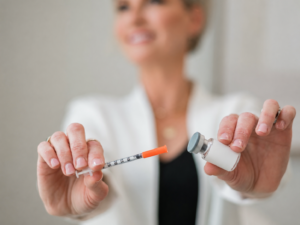
The key word is hollow. Each needle carries a customized serum from the vial mounted on top of the device directly into the skin. As the device stamps gently across the face and décolletage, it delivers thousands of micro-doses of active ingredients exactly where they need to land.
Those serums are mixed by your provider in the treatment room and can include hyaluronic acid for hydration and plumping, peptides for cellular signaling, antioxidants for brightening, micro-doses of neurotoxins for pore refinement, and growth factors. Every cartridge is single-use and single-patient, which is part of why the device is considered medical grade.
A full AquaGold session takes about 15 to 20 minutes of active treatment time, with another 30 minutes spent on consultation and numbing.
Quick distinction. Traditional microneedling is primarily about provoking a wound healing response so the skin rebuilds itself. AquaGold is primarily about delivering active ingredients into the dermis using needles too fine to cause meaningful wounding. |
Side by Side: The Technical Differences
The clearest way to understand these treatments is to look at what is actually happening inside the skin.
Feature | AquaGold Fine Touch | Traditional Microneedling |
|---|---|---|
Needle type | Hollow, 24K gold plated | Solid stainless steel |
Needle depth | Fixed at 0.6 mm | Adjustable, 0.5 mm to 2.5 mm |
Needle size | Thinner than a human hair | Standard microneedling gauge |
Primary mechanism | Microinfusion of serums into the dermis | Controlled micro-injury that signals collagen production |
Treatment time | 15 to 20 minutes | 30 to 45 minutes |
Typical downtime | Pinkness for 30 minutes to a few hours | Redness for 24 to 72 hours |
Best suited for | Glow, hydration, fine lines, superficial concerns | Acne scars, deeper wrinkles, texture irregularities |
Sessions needed | 1 for an event boost or 3 to 4 for cumulative results | 3 to 6 spaced about 4 weeks apart |
Pricing pattern | Higher per session | Lower per session, often sold in packages |
The depth difference matters more than the table might suggest. A clinical study published in the Journal of Clinical and Aesthetic Dermatology found that microneedling produced statistically significant increases in collagen types I, III, and VII over a three-month treatment course, with measurable changes documented in skin biopsies. That kind of structural remodeling requires needles long enough to reach the deeper dermis, which is where traditional microneedling has the advantage.
What Each Treatment Is Best At
The two treatments overlap in what they can address, but each one shines in particular situations.
Traditional microneedling builds new skin from the inside out. Because the needles penetrate deeper and create a stronger healing signal, the procedure delivers measurable improvements in texture and the firmness that age and sun exposure slowly erode, along with real reductions in scar depth. It is the right choice for someone who wants foundational change in skin quality and is willing to give that change three to six sessions over several months to develop.
AquaGold operates on a faster timeline. Within a day or two, skin looks more hydrated and reflective. Pores appear smaller because the micro-Botox in the serum relaxes the muscles around them. Fine lines soften, and the overall complexion takes on what clients often describe as a glass-skin glow. The effect peaks around two weeks after treatment and tends to last between two and four months.
Where AquaGold tends to be the stronger choice:
- Before a wedding, photoshoot, or other event where instant radiance matters more than long term remodeling
- For sensitive areas where deeper microneedling is uncomfortable, such as the under eye region and the décolletage
Where traditional microneedling tends to be the stronger choice:
- Atrophic acne scars and ice pick scars that need physical remodeling of the dermis
- Deeper wrinkles and loss of firmness that surface treatments cannot reach
Discomfort and Recovery
Most clients tolerate both treatments well after numbing cream is applied, but the experiences feel different.
With traditional microneedling, you may notice a vibrating sensation and a light scratching as the device passes over the skin. Bony areas like the forehead and jawline are more sensitive than fleshier parts of the face. After treatment, the skin feels warm and tight for several hours.
With AquaGold, the sensation is closer to a light stamp. The 0.6 mm needles do not reach the deeper nerve fibers that respond to standard microneedling depths, so most clients describe the treatment as mild and oddly relaxing.
Recovery follows the same logic. Traditional microneedling leaves the skin visibly pink for 24 to 72 hours, depending on needle depth, with some mild flaking around day three. AquaGold typically resolves within hours, which is why it is often booked the same week as an important event.
What Results Look Like
Visible change unfolds on different timelines for each treatment.
After AquaGold, the immediate result is hydration and a smoother feel. By the next day skin reflects light more evenly. Pores look refined by day five, and any softening of fine lines tends to peak around two weeks. That peak holds for about two months before gradually fading, which is why a maintenance schedule of every two to three months works for most clients who want to sustain the effect.
After traditional microneedling, the early days are quiet on the surface. Real change begins around three weeks, when new collagen starts laying down. Improvements in texture continue building for up to six months from a single session. Most clients commit to a series of three to six treatments spaced about four weeks apart for cumulative results. Acne scarring may need toward the upper end of that range.
Cost and Value
Pricing varies by region and provider, but the general pattern holds across the country. AquaGold sessions typically cost more per treatment than traditional microneedling because the serums are mixed fresh, the cartridge is single use, and the device itself is more specialized. Traditional microneedling tends to be less expensive per session, with package pricing for a treatment series.
Value depends on what you are buying. If your goal is a glow that lasts through a season, AquaGold delivers efficiently. If your goal is long term remodeling, a series of microneedling sessions costs less over time than repeated AquaGold treatments.
Pairing With Other Treatments
Both treatments fit into a broader skincare plan, and the right sequencing can multiply results.
AquaGold pairs naturally with Botox injections in Meridian, Idaho, because the device can also deliver micro-doses of neurotoxin into the skin itself, addressing pore size and surface texture in ways that traditional Botox placement does not.
Traditional microneedling pairs well with platelet rich fibrin in Meridian, Idaho, where your own growth factors are applied to the skin after the channels are open. This protocol is sometimes called PRF microneedling and it amplifies the regenerative response.
For clients with deeper resurfacing goals, Opus Plasma in Meridian, Idaho reaches further into the dermis than traditional microneedling. For surface refinement between treatments, chemical peels in Meridian, Idaho help maintain smoothness and clarity. Some clients also rotate in a Glo2 Facial in Meridian, Idaho for ongoing oxygenation between deeper sessions.
Volume loss responds better to a different category of treatment entirely. Dermal fillers in Meridian, Idaho restore structure that needles alone cannot rebuild, and our filler guide covers how injectables work alongside skin treatments.
Who Each Treatment Suits
Some skin profiles do better with one approach than the other.
AquaGold tends to suit clients who want a low downtime refresh, have generally healthy skin, and are looking for glow and hydration rather than structural change. It works well for clients with thin or sensitive skin who would find deeper microneedling too aggressive, and for those preparing for a specific date.
Traditional microneedling tends to suit clients with acne scarring, larger pores, sun damage, or visible lines that have moved beyond what surface treatments can address. It also suits clients who prefer to invest in a treatment series with lasting results rather than repeated maintenance sessions.
Neither treatment is appropriate during pregnancy. The same caution applies to skin with an active infection or open wound in the area being treated. A consultation confirms which approach matches your skin and your goals.
Safety Profile
Both treatments have a strong safety record when performed by trained providers using sterile, medical grade equipment. The most common side effects are temporary and resolve within the typical recovery window for each procedure.
After AquaGold, clients occasionally notice mild pinkness, a feeling of warmth, or tiny pinpoint marks that resolve within hours. Serious reactions are uncommon given the shallow depth of the needles and the FDA-cleared status of the device.
After traditional microneedling, clients may notice redness alongside mild swelling and a tight, warm sensation that lasts up to three days. Hyperpigmentation can occur in clients with darker skin tones if aftercare is not followed closely, which is why sunscreen and gentle products matter so much in the first week.
Always share any allergies or current medications during your consultation, along with any recent skin procedures, so your provider can build the safest possible plan.
Aftercare Essentials
Aftercare looks similar for both treatments, with a few key differences in timing.
Aftercare guidelines that apply to both:
- Avoid retinoids, acids, and physical exfoliants for at least three days after treatment
- Use a broad spectrum sunscreen every morning and avoid direct sun exposure while the skin is healing
After AquaGold, makeup can usually go on the same day or the next morning. After traditional microneedling, skip makeup for at least 24 hours and use only gentle, fragrance free products for the first 48 to 72 hours. Avoid saunas, heavy workouts, and very hot water until any redness has fully resolved.
How to Decide Between the Two
If you find yourself drawn to both treatments, it usually means you have a layered set of skin goals. That is normal and often the right read.
A useful framework: AquaGold answers the question of how to look better right now, while traditional microneedling answers the question of how to have better skin over the next year. Many clients run both treatments as part of an annual plan, using microneedling sessions to build a stronger skin foundation and AquaGold treatments to keep the surface looking polished between them.
Your provider can map the sequence in a consultation, taking your timeline and the concerns you want to address into account.
Why YouthLab Aesthetics
The treatment is only as good as the hands performing it. At YouthLab Aesthetics in Meridian, our team has trained extensively in both AquaGold microinfusion and traditional microneedling protocols, and we work with medical grade devices and pharmaceutical grade serums for both.
Our approach prioritizes:
- A thorough consultation that maps your skin goals against the right device for the result you want
- Honest guidance about timelines and what each treatment can realistically deliver
- Personalized aftercare plans built around your lifestyle and your sensitivity
We see skin treatments as long term investments. The right plan often pulls from more than one category, and we build that plan with you rather than for you.
Book Your Consultation in Meridian, Idaho
Choosing between AquaGold and traditional microneedling is easier when someone trained on both can look at your skin and explain what each treatment would actually do for you. At YouthLab Aesthetics, we treat that conversation as the most important part of the process.
Book your consultation today and let us help you decide which approach belongs in your skincare plan.
Your skin deserves a thoughtful answer, not a one size fits all recommendation.
References
- El-Domyati, M., Barakat, M., Awad, S., et al. “Microneedling Therapy for Atrophic Acne Scars: An Objective Evaluation.” Journal of Clinical and Aesthetic Dermatology, 2015. https://pmc.ncbi.nlm.nih.gov/articles/PMC4509584/
- Iriarte, C., Awosika, O., Rengifo-Pardo, M., Ehrlich, A. “Review of applications of microneedling in dermatology and a clinical overview.” Clinical, Cosmetic and Investigational Dermatology, 2017. https://pmc.ncbi.nlm.nih.gov/articles/PMC5556180/
- AQUAGOLD® fine touch™ device information and indications for use. Aquavit Pharmaceuticals. https://aquagoldfinetouch.com/
Recent Blogs